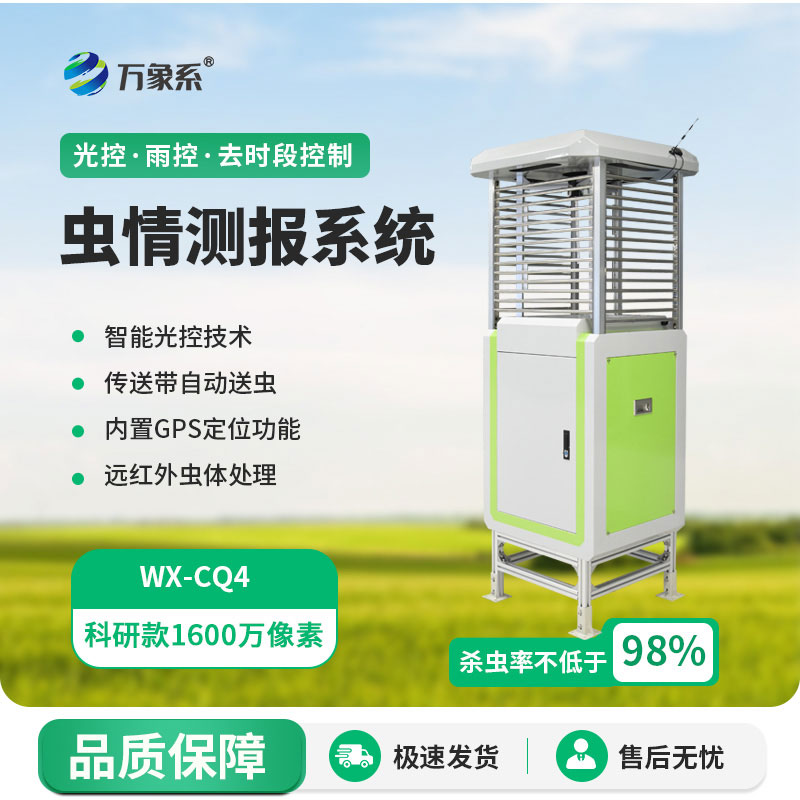
In modern agricultural development, plant protection research, and agro-ecological scientific research, pest dynamic monitoring a core and fundamental link. The population evolution, outbreak patterns, and migration habits of crop pests and diseases directly affect crop yields, ecological balance, and the formulation of pest control strategies For a long time, pest research work in agricultural research institutions, plant protection colleges, and ecological research units has mostly relied on manual field surveys and traditional general monitoring equipment for data collection. Traditional methods are not only time-consuming and labor-intensive with low efficiency, but the collected data are also fragmented and lack precision, making it difficult to meet the high standards of continuity integrity, and standardization required by professional scientific research. General civilian monitoring equipment has simple functions and limited recognition accuracy, making it unable to support in-depth pest data analysis and scientific research experiments which seriously restricts the advancement of agricultural pest and disease scientific research. Against this background, the WX-CQ4 scientific research model pest monitoring device, with its advantages of professional, highprecision, and intelligent monitoring, has become the core specialized equipment for major research institutes, agricultural plant protection departments, and university laboratories to conduct pest research.
The WX-CQ4 research model pest monitoring device is a high-end intelligent monitoring device tailor-made for agricultural scientific research, specialized pest and disease research, and ecological pest surveys. Distinguishing itself from general field equipment, it focuses on scientific-grade data collection and systematic pest analysis, fully adapting to the rigorous standards of professional scientific research. Relying on an integrated operating mode of intelligent pest attraction automatic collection, AI precision recognition, and data retention analysis, it requires no manual supervision or intervention throughout the process, and can automatically capture the dynamic activities of pests in fields, forest areas, and experimental bases24/7. Compared to the basic functions of general equipment that can only perform simple pest quantity statistics, the scientific research model pest monitoring device can achieve refined collection and systematic classification of information, accurately distinguish various pest categories, and completely record core scientific research data such as pest activity periods, population numbers, and activity patterns, providing authentic, standardized, and traceable high data support for pest source tracing research, population dynamic analysis, and pest outbreak prediction research.
Scientific monitoring work has extremely high requirements for environmental adaptability and data stability. The environments of scientific experimental bases, agricultural and forestry experimental fields, and ecological observation areas are complex, with diverse seasonal climate changes. Environmental factors such as wind, rain, dust, high temperature, and high humidity can easily with the monitoring accuracy and operating status of general monitoring equipment. The scientific research model pest monitoring device is exclusively optimized for scientific research scenarios, possessing strong environmental adaptability and anti-interference, and can adapt to the complex environments of various outdoor scientific research experimental sites. The device adopts a professional protective structural design, unafraid of external influences such as sun and rain diurnal temperature differences, and dampness or mold, and can operate stably and uninterruptedly 24/7 all year round, ensuring the continuity of scientific research data and avoiding problems such as data and data distortion caused by equipment failure or environmental interference. Meanwhile, the device is equipped with scientific-grade intelligent algorithms that can automatically filter out interference from debris, flying dust, small flying insects, effectively avoiding invalid data, significantly improving the accuracy of pest data, and fully meeting the data standards for long-term scientific observation and specialized project research
Article address:
http://www.qxhjjc.com/en/newcen/1899.html






 Home
Home phone
phone Product Overview
 Contact Us